
How to Receive USDT and USDC in Bangladesh
This article is for freelancers on Upwork, Fiverr, Toptal, and direct client contracts whose international clients are willing to pay in USDT or USDC. It covers how to set up a wallet, which network to use, how to receive the payment, and how to convert stablecoins to BDT via bKash or a Bangladeshi bank account. For those who want a fully regulated path, there is a separate section on depositing stablecoins directly into a USD account through nsave.
What Are USDT and USDC?
USDT (issued by Tether) and USDC (issued by Circle) are stablecoins, which are digital tokens pegged 1:1 to the US dollar, meaning 1 USDT equals $1.00 USD at all times. Unlike Bitcoin, stablecoins do not fluctuate in value. They settle on a blockchain network, so transfers complete in minutes without requiring a bank to process the payment.
For a Bangladeshi freelancer, the practical difference is this: you receive dollar-equivalent value without waiting for a bank's processing window or losing money to exchange rate movement during transit. USDT has deeper P2P liquidity in Bangladesh, making it easier to sell locally via Binance or Bitget. USDC is more widely accepted by US-based clients and is considered more transparent, as Circle publishes monthly reserve attestations confirming the backing of every token in circulation.
Is Receiving USDT and USDC Legal in Bangladesh?
Bangladesh Bank does not recognise stablecoins or cryptocurrency as legal tender. Bangladesh Bank has issued warnings against cryptocurrency use, citing the Foreign Exchange Regulation Act 1947 and the Money Laundering Prevention Act 2012. No formal legal framework exists for crypto in Bangladesh. Using cryptocurrency to receive freelance income sits in a regulatory grey area, not a criminalised zone with active enforcement against individual users. That said, Bangladesh Bank's position is clearly opposed, and users operate at their own risk.
As of March 2026, Cryptocurrency (USDT via Binance P2P) is used as a grey-area workaround for international income receipt in Bangladesh. However, this is not legal in Bangladesh. Under the Foreign Exchange Regulation Act, 1947, and the Anti-Money Laundering Act, 2012, cryptocurrency is not recognized as legal tender. Unlike legal channels (like nsave or Elevate), crypto transfers do not qualify for the 2.5% government cash incentive on remittances.
If regulatory compliance is a concern, a regulated non-resident USD account is a fully lawful alternative for receiving international earnings. The supplementary section below covers how nsave supports this path, including direct stablecoin deposit into a regulated USD account.
How to Set Up a Wallet to Receive USDT or USDC in Bangladesh
To receive USDT or USDC, you need either a self-custody wallet such as Trust Wallet or MetaMask, or an exchange account wallet on Binance or Bitget.
Self-Custody Wallets (Trust Wallet, MetaMask)
To set up a self-custody wallet, download Trust Wallet or MetaMask, create an account, and write down the 12-word recovery phrase. The recovery phrase is the only way to recover access if you lose your device. These wallets generate a wallet address for each supported network without requiring registration with any exchange and without KYC identity verification. Self-custody wallets are the better option for users who want full control of their funds without disclosing personal documents.
Exchange Account Wallets (Binance, Bitget)
To receive stablecoins via Binance or Bitget, create an account, complete identity verification using a national ID or passport, and navigate to the deposit section to generate your wallet address. Exchange wallets are the better option for users who plan to convert USDT to BDT immediately via the platform's P2P marketplace, because the stablecoin and the conversion tool are in the same place.
Which Network Should You Use to Receive USDT or USDC?
Network selection is the most important technical decision in receiving stablecoins. Sending USDT or USDC on the wrong network results in permanent loss of funds because the transaction cannot be reversed. Bangladeshi users encounter 4 networks most frequently: TRC20, ERC20, BEP20, and Solana.
TRC20 (Tron Network)
TRC20 is the network with the lowest fees for receiving USDT. Transaction fees are typically under $0.10, and settlement takes 1 to 3 minutes. It is the standard choice for P2P transactions and direct client payments in Bangladesh. Confirm your wallet supports TRC20 before sharing the address. The nsave in-app crypto deposit does not currently support TRC20. To deposit USDT via TRC20 into a nsave USD account, use the nsave crypto web portal at web.nsave.com.
ERC20 (Ethereum Network)
ERC20 is the original network for USDC and is widely used by US-based clients. Network fees (gas fees) range from $2 to $20 or more depending on Ethereum network congestion at the time of the transaction. ERC20 is appropriate when your client specifically requests it or sends USDC. Avoid ERC20 for payments under $100. A $10 gas fee on a $50 transfer represents a 20% cost before any other deduction.
BEP20 (Binance Smart Chain)
BEP20 offers fees typically under $0.50 and fast settlement. Binance and Bitget both support BEP20 extensively. It is a practical network choice if your client uses Binance to send the payment.
Solana Network
Solana transactions settle within seconds and fees are typically under $0.01. Solana is the network supported by the nsave in-app crypto deposit for USDC. A client who sends USDC on Solana provides the fastest and lowest-cost route into a nsave USD account.
For example, if a client sends you $200 in USDT on ERC20 when you gave them a TRC20 address, the funds will not arrive in your TRC20 wallet. The transaction goes to a different address on the Ethereum blockchain. Always confirm the network name in writing before the client sends any amount.
How to Receive USDT or USDC
To receive USDT or USDC, share your wallet address and the correct network name with your client before they initiate the transfer.
Step 1: Generate Your Wallet Address
In your wallet app or exchange account, navigate to Receive, select USDT or USDC, then select the network (TRC20, ERC20, BEP20, or Solana). Your wallet address appears as both a QR code and an alphanumeric string.
Step 2: Confirm the Network with Your Client
Send your client both the wallet address and the network name in writing. Write the instruction clearly: "Please send USDT via TRC20 to: [your address]." Never assume the client knows the network. Always specify both the asset and the network in the same message.
Step 3: Test with a Small Amount First
For a first payment from a new client, ask them to send a test amount of $5 to $10 before releasing the full invoice amount. Confirm the test amount arrives before requesting the full payment.
Step 4: Confirm Receipt
In your wallet or exchange account, check the transaction history. USDT and USDC on TRC20 and BEP20 confirm within 1 to 3 minutes. Solana confirms within seconds. ERC20 confirmation time varies from 5 to 30 minutes depending on network congestion. Once confirmed, the balance appears in your wallet.
How to Convert USDT or USDC to BDT
To convert USDT or USDC to Bangladeshi Taka, use the P2P marketplace on Binance or Bitget to sell your stablecoins to a verified Bangladeshi buyer who pays in bKash, Nagad, or direct bank transfer.
Using Binance P2P
On Binance, navigate to Buy/Sell, select P2P Trading, then Sell, then USDT, and filter by BDT payment method, including bKash, Nagad, or bank transfer. Select a verified merchant with a high completion rate and a confirmed trade history. Enter the USDT amount. Binance holds your USDT in escrow until the buyer confirms payment. Release the USDT only after BDT has arrived and your bKash or bank balance reflects the credited amount.
Using Bitget P2P
Bitget P2P uses the same escrow structure. Navigate to P2P, select Sell, select USDT, then select BDT as the payout currency. Bitget has a growing number of Bangladeshi traders and is an alternative when Binance P2P spreads are unfavourable on a given day.
Avoiding P2P Fraud
Never release USDT before confirming that BDT has landed in your account. Do not rely on payment screenshots. Check your actual bKash notification or bank balance before releasing anything. Use only merchants with 100 or more completed trades and above a 95% completion rate. The escrow holds your funds until you manually release them, so releasing early removes that protection entirely.
For example, if you sell 100 USDT and the buyer sends a bKash screenshot but no notification has arrived on your phone, do not release the USDT. Wait until the BDT amount appears in your actual account balance.
USDT vs USDC for Bangladeshi Freelancers
USDT has deeper P2P liquidity in Bangladesh and is the standard stablecoin on Binance and Bitget P2P. USDC is more widely accepted by US-based clients and is considered more transparent, as Circle publishes monthly reserve attestations.
| USDT | USDC | |
|---|---|---|
| P2P liquidity in Bangladesh | High | Lower |
| Typical network fees | Under $0.10TRC20/Solana | Under $0.01Solana |
| Client acceptance | Broad | Strong with US-based clients |
| nsave in-app deposit support | Web portalTRC20/other networks | Yes, via Solana in-app |
For most Bangladeshi freelancers, USDT on TRC20 is the practical standard for P2P conversion: lower per-transaction cost and stronger local demand. USDC on Solana is the preferred choice for depositing directly into a nsave USD account.
Common Problems When Receiving Stablecoins
Wrong Network Transfer
Sending USDT on ERC20 to a TRC20 address, or sending USDC on the Ethereum network to a Solana address, results in permanent fund loss. Contact your wallet provider immediately if this happens. Some wallets can recover cross-chain deposits, but recovery is not guaranteed. Prevention through written network confirmation before every transfer is the only reliable protection.
Delayed Confirmation
USDT on TRC20 confirms within 1 to 3 minutes under normal conditions. ERC20 takes 5 to 30 minutes during peak periods. Solana confirms within seconds. If a transaction is delayed, check the transaction hash on the relevant block explorer. Use Tronscan for TRC20, Etherscan for ERC20, and Solscan for Solana to confirm whether the transaction was broadcast and is pending, rather than failed.
Wallet Address Errors
A single character error in a wallet address means funds are sent to an unreachable destination with no possibility of reversal. Always copy-paste wallet addresses and never type them manually. After pasting, confirm that the first and last four characters match the original address exactly.
P2P Payment Disputes
If a P2P buyer claims payment was sent but BDT has not arrived, do not release the USDT. File a dispute through the platform's dispute resolution system. The escrow remains locked until the platform resolves the case. Releasing funds before the dispute closes forfeits your protection.
Safety Practices for Receiving Stablecoins in Bangladesh
Your exchange accounts and wallets carry 4 non-negotiable safety requirements:
- Enable two-factor authentication on all exchange accounts before making any transaction.
- Never share your wallet seed phrase with any person or platform under any circumstances.
- Verify the full wallet address string after pasting, not just the first few characters.
- Use only established, high-volume P2P traders for conversion: check completion rate, total trade count, and user reviews before selecting a counterparty.
Self-custody wallets give full control of funds but carry no account recovery option if you lose your seed phrase. Exchange accounts provide recovery options but require you to trust the platform with custody of your funds during the period they are held there.
Once USDC or USDT lands in your wallet, the next question is what to do with it. Selling via P2P works, but it requires finding a merchant, waiting for BDT to arrive, and managing the escrow manually every time. A simpler path: deposit your stablecoin directly into a nsave USD account, where it automatically converts to USD, earns daily rewards, and can be sent to your local bank account or bKash whenever you're ready, without any P2P marketplace involved.
How to Deposit USDC or USDT into nsave
To deposit stablecoins like USDT into nsave, open the nsave app, navigate to your USD account, tap Deposit, and select the crypto deposit option. Your USDC converts to USD automatically on arrival.
Step 1: Open Your nsave USD Account
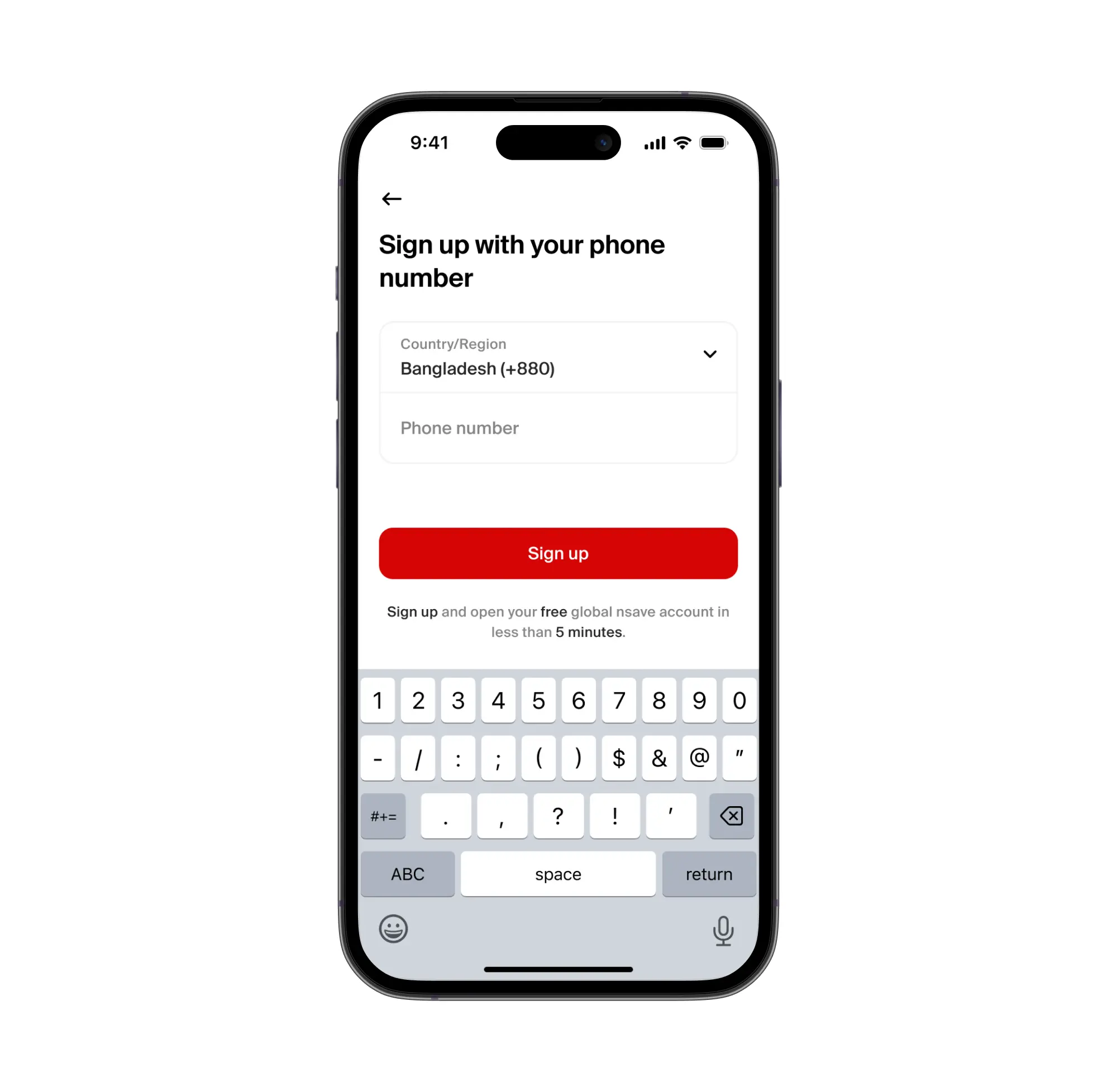
The nsave Standard plan carries no monthly fee. Open an account via the mobile app in under 10 minutes using a passport or national ID. No branch visit is required. Once verified, you receive a personal USD account with an ACH routing number and account number, plus access to the crypto deposit feature.
Step 2: Get Your nsave Deposit Address

In your nsave app, go to your USD account, tap Deposit, and select the crypto deposit option. Two dropdowns appear: Network and Asset. As of May 9th, the in-app deposit currently supports USDC on the Solana network only. Select Solana and USDC, then tap Show Address.

Accept the disclaimer, which confirms that the asset and network must match exactly what you are sending, or funds will be lost permanently. Your personal nsave wallet address appears as a QR code and an alphanumeric string. Always copy the address using the copy icon and never type it manually.

Step 3: Send USDC from Your Wallet or Exchange
From your wallet or exchange account, including Binance, Coinbase, Revolut, or Kraken, initiate a withdrawal. Select USDC as the asset and Solana as the network. Both must match the nsave deposit screen exactly. Paste the nsave wallet address and confirm. For your first deposit, start with a small test amount. Some platforms charge a fixed withdrawal fee regardless of the amount sent. Confirm the fee on the sending platform before committing a large transfer. Solana transactions typically confirm within seconds to a few minutes.
Step 4: Funds Convert to USD Automatically

When USDC arrives at your nsave wallet address, it converts to USD automatically and is added to your nsave USD balance. No manual conversion step is required. The transaction appears in your history labelled "Crypto deposit from SOLANA." To deposit via a different network or a different stablecoin, including USDT, DAI, USDP, or PYUSD across Ethereum, Polygon, Base, Arbitrum, Avalanche, Optimism, or Stellar, use the nsave web portal at web.nsave.com instead of the app.
Step 6: Send BDT to Your Local Account or bKash
When you are ready to withdraw, initiate a local currency payout in the app. The app shows the exact BDT amount before you confirm. Check today's rate and fee at nsave.com/send-money-home. BDT is credited to your Bangladeshi bank account or bKash.
nsave is not a bank. Funds are not FSCS-protected. Customer funds are held in regulated UK and EEA financial institutions, separated from company funds, and protected through safeguarding rules designed for electronic money services.
Can I Deposit USDT or USDC via Binance in Bangladesh?
Yes. Binance allows Bangladeshi users to hold USDT and USDC and supports withdrawals to external wallet addresses, including the nsave crypto deposit address. To move stablecoins from Binance into a regulated USD account, withdraw USDC on Solana from Binance directly to your nsave wallet address. Binance operates in a legal grey area in Bangladesh and does not offer a USD account with ACH details or direct BDT payouts. nsave provides both.
Another common workaround for receiving payment from abroad is using Binance (a popular cryptocurrency exchange platform) and cashing out via MFS or bank transfer. However it should be noted that this is illegal in Bangladesh as cryptocurrencies are not recognised as legal tender in Bangladesh's existing financial laws in Bangladesh.
Can I Use Bitget to Send Stablecoins to nsave?
Yes. Bitget supports USDC and USDT withdrawals to external wallet addresses. To move stablecoins from Bitget into a regulated USD account, withdraw USDC on Solana to your nsave wallet address. Bitget does not offer a USD account with ACH details, so clients who pay by bank transfer cannot use Bitget as a payout destination. nsave covers both payment methods, ACH receipt and stablecoin deposit, in one account.
Can I Use Wise to Receive Stablecoin Payments?
No. Wise does not accept stablecoin deposits. Wise provides USD accounts with ACH details for receiving bank transfers from international clients and platforms.
What Getting Paid in Stablecoins Actually Makes Possible
Stablecoin payments started as a workaround for missing infrastructure. PayPal is blocked. Stripe is unavailable. SWIFT fees absorb a meaningful share of small invoices. USDT and USDC filled the gap because they work where formal systems do not. For Bangladeshi freelancers who can now set up a regulated USD account, deposit stablecoins directly into it, and send BDT to a local bank account or bKash from there, the workaround has become a full payment path. The friction that drove freelancers to grey-area P2P markets no longer has to be the default.
The information in this article is provided for general informational and educational purposes only and does not constitute financial, legal, or tax advice from nsave or any of its affiliates. It is not a substitute for advice from a qualified financial adviser. We make no representations or warranties, whether expressed or implied, that the content is accurate, complete, or up to date.
Fees, exchange rates, incentives, and product availability may change and can vary by user and jurisdiction. Examples are illustrative only. Before making any financial decisions, seek advice from a qualified financial adviser who can assess your individual circumstances and objectives.
nsave helps freelancers and professionals from Bangladesh, Nigeria, Pakistan, Egypt, and other emerging markets receive and manage USD abroad. As a non-bank payment provider, your money is not protected by the Financial Services Compensation Scheme (FSCS). Customer funds are held in regulated, UK and EEA financial institutions, separated from company funds, and protected through safeguarding rules designed for electronic money services.
