
Banks in Pakistan: List of Commercial, Islamic, Digital, and Foreign Banks

As of 2026, Pakistan has 33 scheduled banks, 10 microfinance banks, 3 licensed digital banks, and 6 electronic money institutions, all regulated by the State Bank of Pakistan. That scale tells one story.
A significant share of the population still sits outside the formal banking system, which is why the SBP's financial inclusion target runs to 75% by 2028.
Complete List of Banks in Pakistan
Pakistan's banking sector is divided into 6 regulated categories: public sector commercial banks, private commercial banks, Islamic banks, foreign banks, microfinance banks, and digital banks, all operating under licences issued by the State Bank of Pakistan.
Public Sector Commercial Banks
Public sector commercial banks are majority government-owned and operate under an SBP commercial banking licence. Pakistan has 5 public sector commercial banks:
| Bank Name | Founded | Current Head (as of March 2026) | Ownership Note |
|---|---|---|---|
| National Bank of Pakistan (NBP) | 1949 | President/CEO: Rehmat Ali Hasnie | Federal government-owned; principal agent for government transactions1,500+ branches |
| Bank of Punjab (BOP) | 1989 | President: Zafar Masud | Punjab provincial government-owned |
| Bank of Khyber (BOK) | 1991 | Managing Director/CEO: Hassan Raza | Khyber Pakhtunkhwa provincial government-owned |
| Sindh Bank | 2010 | President/CEO: Muhammad Anwaar | Sindh provincial government-owned |
| First Women Bank Limited (FWBL) | 1989 | President: Farrukh Iqbal Khan | Federal government-ownedFocused on women's financial inclusion |
Government ownership means these banks carry sovereign backing, which makes them stable but often slower to innovate than private competitors. That stability is a feature for some customers and a limitation for others, depending on what they need from a bank.
Domestic Private Commercial Banks
Private commercial banks are incorporated in Pakistan and owned by the private sector. They hold the majority of retail and corporate banking activity in the country. As of March 2026, Pakistan has 20 domestic private scheduled banks:
| Bank Name | Current Head (as of March 2026) | Key Note |
|---|---|---|
| Allied Bank Limited (ABL) | President/CEO: Aizid Razzaq Gill | Strong rural and urban branch networkmyABL digital platform |
| Askari Bank Limited | President/CEO: Zia Ijaz | Backed by Fauji GroupStrong military-community presence |
| Bank Alfalah Limited | President: Atif Aslam Bajwa | Abu Dhabi Group-backedConsumer finance innovation |
| Bank Al Habib Limited | President: Mansoor Ali Khan | Conservative, well-rated for retail banking |
| Faysal Bank Limited | President: Yousaf Hussain | Converted to full Islamic banking in 2022 Islamic |
| Habib Bank Limited (HBL) | President/CEO: Muhammad Nassir Salim | Pakistan's largest bank by assets1,700+ branches |
| Habib Metropolitan Bank Limited | President/CEO: Khurram Shahzad Khan | HabibMetroSubsidiary of Habib Bank AG Zurich |
| JS Bank Limited | President: Basir Shamsie | Branchless banking and digital services |
| MCB Bank Limited | President/CEO: Muhammad Nauman Chughtai | One of Pakistan's oldest private banksFounded 1947 |
| Samba Bank Limited | President/CEO: Rashid Jahangir | Saudi-connectedCorporate and SME focus |
| Soneri Bank Limited | President: Muhtashim Ahmad Ashai | Mid-sized retail bank with Islamic window |
| Standard Chartered Bank (Pakistan) Limited | President/CEO: Rehan Sheikh | UK-originRetail and corporate |
| United Bank Limited (UBL) | President/CEO: Muhammad Jawaid Iqbal | Digital banking leaderInternational corridors for diaspora |
| Bank Makramah Limited | Not publicly listed as of March 2026 | Newer Islamic bank with full Shariah structure Islamic |
| Meezan Bank Limited | President: Syed Amir Ali | Pakistan's largest Islamic bank Islamic |
| BankIslami Pakistan Limited | President/CEO: Rizwan Ata | Full-fledged Islamic bank Islamic |
| Dubai Islamic Bank Pakistan Limited | President/CEO: Muhammad Ali Gulfaraz | UAE-backed Islamic bank Islamic |
| Al Baraka Bank (Pakistan) Limited | President/CEO: Muhammad Atif Hanif | Bahrain-owned Islamic bank Islamic |
| MCB Islamic Bank Limited | President/CEO: Hammad Khalid | Islamic-only subsidiary of MCB Bank Islamic |
| Silk Bank Limited | Not publicly listed as of March 2026 | Subsidiary of United Bank Limited UBL subsidiary |
Note: Several banks operate dual conventional and Islamic licences. Faysal Bank completed its full conversion to Islamic banking in 2022, making it a full-fledged Islamic bank rather than a conventional bank with an Islamic window.
Specialised and Development Banks
Specialised banks in Pakistan serve specific economic sectors. Pakistan has 3 such institutions:
| Bank Name | Current Head (as of March 2026) | Mandate |
|---|---|---|
| Zarai Taraqiati Bank Limited (ZTBL) | President/CEO: Tahir Yaqoob Bhatti | Agricultural financingFormerly Agricultural Development Bank of Pakistan |
| SME Bank Limited | Not publicly listed as of March 2026 | Small and medium enterprise financing |
| Punjab Provincial Cooperative Bank Limited (PPCBL) | President/CEO: Shahram Raza Bakhtiari | Cooperative bankingPrimarily Punjab-based |
These banks do not offer general retail accounts and are not set up for freelancers or remote workers seeking payment receipt infrastructure.
Foreign Banks
Foreign banks operating in Pakistan hold an SBP licence but are incorporated outside the country. As of 2025, 5 foreign banks hold scheduled bank status in Pakistan:
| Bank | Country of Origin | Current Head (as of March 2026) | Primary Focus |
|---|---|---|---|
| Standard Chartered Bank (Pakistan) Limited | 🇬🇧 United Kingdom | President/CEO: Rehan Sheikh | Retail and corporate bankingOperating in Pakistan since 1863 |
| Citibank N.A. | 🇺🇸 United States | President/CEO: Habib Yousuf Habib | Corporate and institutional banking |
| Industrial and Commercial Bank of China (ICBC) | 🇨🇳 China | Country Head/President: Zhou Bo | CPEC-linked corporate finance CPEC |
| Deutsche Bank AG | 🇩🇪 Germany | Country Head/President: Ali Haider Zaidi | Corporate banking and treasury services |
| Bank of China | 🇨🇳 China | Country Head/President: Wenlong Zhu | Trade finance and corporate services CPEC |
For freelancers and remote workers, foreign banks offer limited retail access in Pakistan. Standard Chartered is the most accessible foreign bank for individual account holders.
Microfinance Banks
Microfinance banks are licensed under the Microfinance Institutions Ordinance 2001 and regulated by the SBP. Their focus is small-ticket lending and deposits for low-income individuals and micro-enterprises.
As of 2026, Pakistan has 10 microfinance banks with 1,329 branches collectively:
- Easypaisa Bank Limited (formerly Telenor Microfinance Bank)
- Mobilink Microfinance Bank Limited (operating as JazzCash)
- Khushhali Microfinance Bank Limited
- The First Microfinance Bank Limited
- NRSP Microfinance Bank Limited
- U Microfinance Bank Limited
- FINCA Microfinance Bank Limited
- Pak Oman Microfinance Bank Limited
- Sindh Microfinance Bank Limited
- Advance Pakistan Microfinance Bank Limited
Easypaisa and JazzCash are the two that most Pakistani professionals encounter daily, because they power mobile wallet payments across the country.
SBP-Licensed Digital Banks
Digital banks in Pakistan operate under a dedicated SBP Digital Bank Licensing Framework issued in 2022. They have no physical branches and deliver all services through a mobile app.
As of 2026, Pakistan has 3 major licensed digital banks:.
| Bank | Current Head (as of March 2026) | Key Features |
|---|---|---|
| Easypaisa Bank Limited | President/CEO: Jahanzeb Khan | Pakistan's largest digital bank; 55+ million users Full digital banking including term deposits and micro-enterprise lending Telenor GroupAnt Group |
| Raqami Islamic Digital Bank Limited | President/CEO: Umair Aijaz | Pakistan's first branchless Islamic digital bank Qard-based current accounts, Mudarabah savings, and term deposits IslamicPKIC & Enertech-backed |
| Mashreq Bank Pakistan Limited | President/CEO: Muhammad Hamayun Sajjad | UAE-origin digital bank with Islamic-first positioning Building its customer base as of 2026 IslamicUAE-origin |
Note: SadaPay and NayaPay are Electronic Money Institutions, not licensed digital banks. Their structure and limitations are covered in the next section.
Electronic Money Institutions
Electronic Money Institutions are licensed by the SBP under the Regulations for Electronic Money Institutions (2019). They issue e-money and operate digital wallets but do not lend, and they must hold customer funds in a licensed bank.
6 EMIs are currently live in Pakistan:
- NayaPay: Pakistan's first SBP-licensed EMI (2021); Visa debit card; strong Raast integration; popular with freelancers for bill payments.
- SadaPay: Licensed in 2022; Mastercard debit card; acquired by Turkish fintech Papara for $50 million in 2024; supports Payoneer withdrawals.
- Finja: Focused on MSMEs and supply chain payments.
- Akhtar Fuiou Technologies.
- E-Processing Systems (M/s CMPECC Pvt Ltd)
- Wemsol Private Ltd.
NayaPay and SadaPay are not banks. Customer funds are held in trust at a licensed bank, not on the EMI's balance sheet, and that distinction matters because it determines what protections apply to your money.
How Pakistan's Banking Sector Is Organised
All banks in Pakistan operate under licences issued by the State Bank of Pakistan, the country's central bank.
A scheduled bank is a bank included on the SBP's official schedule of licensed institutions, which grants access to SBP credit facilities and signals full regulatory oversight.
The distinction between a scheduled bank, a microfinance bank, a digital bank, and an EMI matters in practice because it determines 3 things for a customer:
- Whether the institution can lend (scheduled and microfinance banks can; EMIs cannot)
- Whether the account earns a profit rate or holds funds on a Qard basis.
- What recourse exists if the institution fails.
The Role of the State Bank of Pakistan
The SBP is the central bank and primary banking regulator, established in 1948.
According to a 2025 State Bank of Pakistan report on the banking sector, the SBP issues banking licences, sets monetary policy, operates the Raast instant payment system, and publishes the official schedule of licensed banks.
As of March 2025, the SBP policy rate stands at 10.5%. The SBP's financial inclusion target is 75% of Pakistanis banked by 2028.
Commercial Banks in Pakistan
Pakistan's commercial banks offer the full range of retail and corporate banking services, including current and savings accounts, loans, trade finance, foreign currency accounts, and digital banking.
The 5 largest private commercial banks by assets and branch network each serve a distinct customer type.
1. Habib Bank Limited (HBL)
Habib Bank Limited is Pakistan's largest commercial bank by assets and branch network, founded in 1941. As of May 2026, HBL is led by President Muhammad Nassir Salim. HBL is known for 3 things: its wide physical presence across Pakistan and abroad, its corporate banking strength, and its Konnect branchless banking service for rural and underbanked areas. That combination of scale and reach makes HBL the natural fit for large corporate clients and customers who need physical coverage across cities and rural areas alike.
2. United Bank Limited (UBL)
UBL is one of Pakistan's most digitally advanced commercial banks, founded in 1959. As of May 2026, UBL is led by President Muhammad Jawaid Iqbal. UBL's primary advantage is its international banking corridors for overseas Pakistanis, combined with a feature-rich mobile banking app. According to the 2025 UBL Annual Report on digital banking, UBL processes international remittances through dedicated overseas corridors and offers full in-app USD-to-PKR conversion for foreign currency account holders.
3. MCB Bank Limited
MCB Bank is one of Pakistan's oldest private commercial banks, founded in 1947. As of May 2026, MCB is led by President Muhammad Nauman Chughtai. MCB's 3 core strengths are financial stability, SME financing, and retail banking depth, and these make it the right fit for retail customers and businesses seeking an established institution with a conservative balance sheet.
4. Allied Bank Limited (ABL)
Allied Bank is led by President/CEO Aizid Razzaq Gill as of May 2026. ABL is known for its myABL digital platform and a branch network that spans both urban and rural areas. That reach makes ABL a solid everyday banking option for customers in Pakistan's smaller cities and towns, where branch proximity still matters.
5. Bank Alfalah
Bank Alfalah is part of the Abu Dhabi Group and has been one of Pakistan's fast-growing private banks since 1997. As of March 2026, Bank Alfalah is led by President Atif Aslam Bajwa. The bank is known for consumer finance innovation and credit card products.
Islamic Banks in Pakistan
Islamic banks in Pakistan operate entirely under Shariah principles. They do not charge or pay interest, and instead use 4 primary product structures;
1. Profit-sharing arrangements (Mudarabah)
2. Cost-plus financing (Murabaha)
3. Lease-based structures (Ijarah)
4. Demand deposit arrangements (Qard).
According to a 2025 SBP Financial Stability Review on Islamic banking, Islamic banking assets in Pakistan reached Rs 14.47 trillion by December 2025, representing 22.9% of total banking assets and growing 30.7% year-on-year.
That growth rate outperformed conventional banks for the second consecutive year. To put Rs 14.47 trillion in context, it represents more than the combined GDP of the 10 smallest provincial economies in Pakistan.
And yet this is structural growth, not a cyclical spike: the Federal Shariat Court has ordered the full elimination of interest-based banking by 2027, which means Islamic banking's rising share of the sector is built into the regulatory direction of travel.
Major Islamic Banks in Pakistan
Pakistan has 4 full-fledged Islamic banks operating without any conventional banking activity. They include:
- Meezan Islamic Banks
- Bank Islami Pakistan Limited
- Dubai Islamic Bank Pakistan
- Al Baraka Bank (Pakistan)
Meezan Bank is Pakistan's largest Islamic bank, led by President Syed Amir Ali as of March 2026. According to a 2025 Meezan Bank annual performance summary on Shariah-compliant banking, Meezan has been named Best Bank of Pakistan for three consecutive years from 2023 to 2025.
Bank-Islami Pakistan Limited operates as a full-fledged Islamic bank led by President/CEO Rizwan Ata as of March 2026, with commercial banking and FX dealer authorisation from the SBP.
Dubai Islamic Bank Pakistan is UAE-backed, led by President/CEO Muhammad Ali Gulfaraz, and carries the full Shariah banking framework of its parent group. is Bahrain-owned, led by President/CEO Muhammad Atif Hanif, and has operated in Pakistan since 1991.
Al Baraka Bank (Pakistan) is Bahrain-owned, led by President/CEO Muhammad Atif Hanif, and has operated in Pakistan since 1991.
Digital Banking and Electronic Money Institutions in Pakistan
Digital banking in Pakistan covers 2 distinct categories: SBP-licensed digital banks, which can take deposits and lend, and Electronic Money Institutions, which hold e-money but cannot lend.
The practical difference matters because an EMI account is not a bank account. It is a prepaid wallet backed by funds held in trust at a licensed bank.
The Raast Payment System
Raast is the SBP's instant payment infrastructure and the underlying rails used by banks, microfinance institutions, and EMIs to move money in real time.
According to a 2025 SBP Raast overview on payment infrastructure, Raast had 48 million registered users by 2025, processed nearly Rs 50 trillion, and completed close to 2 billion transactions.
To contextualise that volume: Rs 50 trillion is equivalent to roughly 14% of Pakistan's total banking sector assets. Government salaries and pensions now flow through Raast.
Users link a Raast ID, typically their mobile number, to any participating account and send or receive money instantly at no charge.
Foreign Currency and Overseas Pakistani Banking
For overseas Pakistanis and non-residents, Pakistan's banking system offers 2 main entry points: foreign currency accounts at licensed banks, and the Roshan Digital Account, a remote account-opening scheme available through multiple SBP-licensed institutions.
Roshan Digital Account
The Roshan Digital Account (RDA) is an SBP initiative that allows overseas Pakistanis and certain foreign nationals to open and operate a Pakistani account entirely online from abroad.
According to a 2025 SBP Roshan Digital Account overview on non-resident banking, total inflows through the RDA programme have crossed $11 billion and active accounts exceed 890,000 as of 2025.
The RDA is available in 4 currencies: PKR, USD, GBP, and EUR. Participating banks include Meezan Bank, HBL, UBL, MCB Bank, Bank Alfalah, and Standard Chartered Pakistan.
Foreign Currency Accounts at Local Banks
Most major commercial and Islamic banks in Pakistan offer foreign currency accounts in USD, GBP, and EUR. These accounts accept inward remittances via SWIFT transfer.
Now, here is an important limitation for anyone earning from international platforms: local Pakistani bank accounts do not accept ACH transfers from US-based platforms.
Discussions within Pakistani freelancing communities as recently as 2025 report that receiving international transfers into a Pakistani bank requires sharing both an IBAN number and a SWIFT code, with the SWIFT code serving the routing function that connects the overseas sender's bank to the recipient's institution.
For users accustomed to platform-based payments, this two-piece requirement is not immediately obvious, and providing only an IBAN without a SWIFT code results in delayed or failed transfers.
Here's what that means in practice. Most US-based payment platforms like Fiverr, Upwork disburse via ACH, not SWIFT, so freelancers earning from these platforms either route payments through Payoneer first, which accepts ACH and provides a PKR withdrawal, or hold a separate international USD account alongside their local account and convert to PKR on their own schedule.
Hence the need for platform that allows both SWIFT and ACH.
How to Receive USD Earnings with nsave
For Pakistani professionals earning in USD from international clients or platforms, nsave provides a USD account with its own ACH routing number and account number.
That is the format used by Upwork, Fiverr, Deel, and most US-based clients to pay contractors directly, without the ACH-to-SWIFT conversion step that a local Pakistani bank requires.
Discussions within Pakistani freelancing communities frequently recommends nsave as one of the best solution for receiving international client payments, describing it as a low-fee option comparable to Wise.
nsave is not a bank. It is a non-bank international payment platform that gives users from Pakistan, Bangladesh, Nigeria, Egypt, and other emerging markets access to USD, GBP, and EUR accounts abroad.
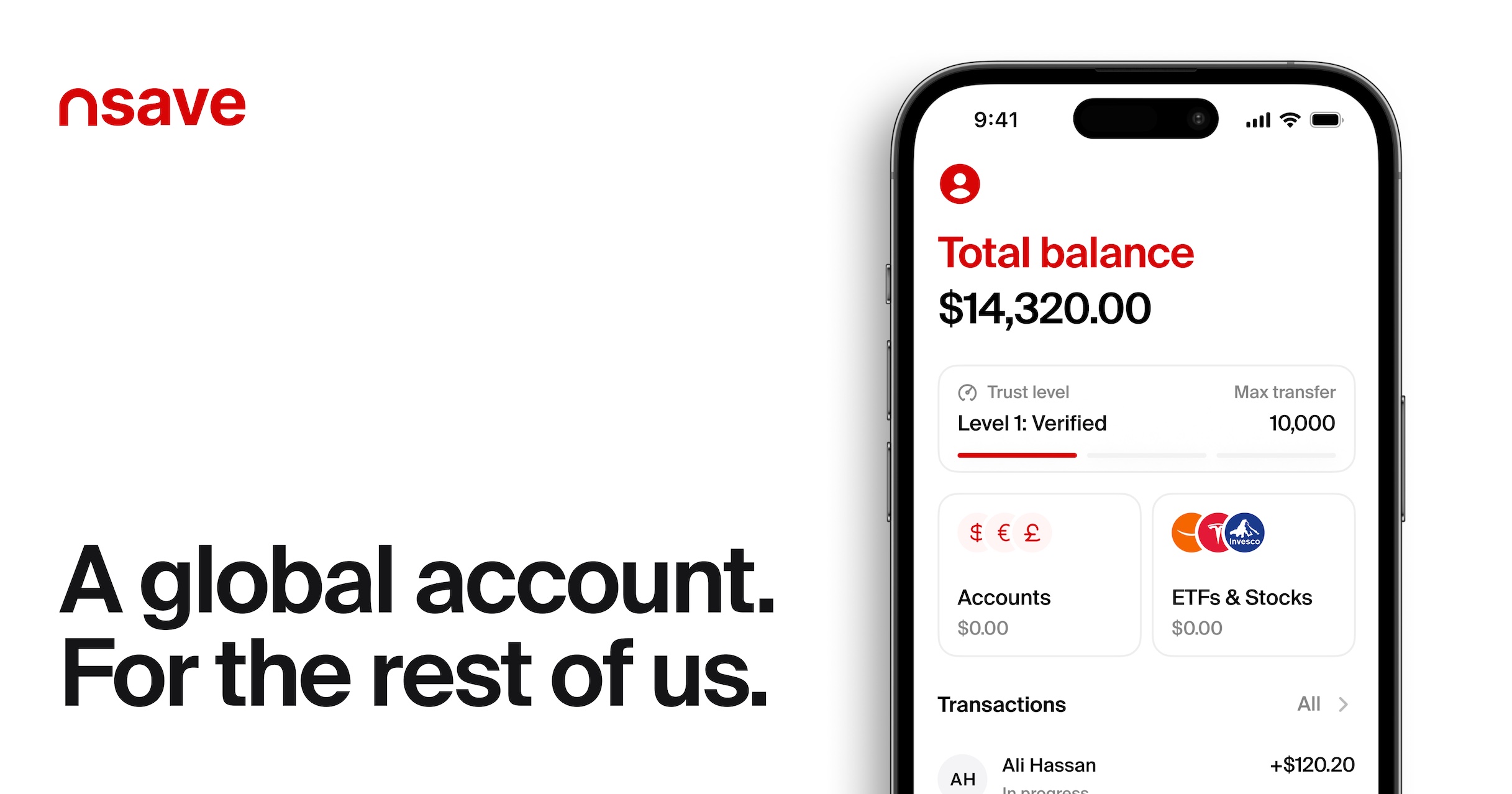
To open an nsave account, there are 4 steps:
- Download the nsave app and complete identity verification using a passport.
- Receive your personal ACH routing number and account number for USD transfers.
- Share those details with any client or platform that pays via ACH.
- Convert USD to PKR with a minimum $1 fee and transfer to any Pakistani bank account.
nsave also provides 3.2% annual rewards on USD balances held in the account and access to US stocks and ETFs from $1 with zero order fees.
For Pakistanis earning in USD who want to receive, hold, and invest from a single account, nsave covers all 3 functions under a $0 Standard plan.
Access to a functioning USD account changes the financial equation for a Pakistani professional.
The difference between routing payments through a local bank with SWIFT-only infrastructure and branch-based conversion, versus receiving directly via ACH into an account you control from your phone, is not a technical detail.
For freelancers managing monthly earnings in USD, the choice of account shapes how much they keep, how quickly they access it, and whether they can hold it in dollars long enough to decide when to convert.
Pakistan's banking sector now offers more paths than it did five years ago, and the right path depends entirely on how, and from where, the money is moving.
The information in this article is provided for general informational and educational purposes only and does not constitute financial, legal, or tax advice from nsave or any of its affiliates. It is not a substitute for advice from a qualified financial adviser. We make no representations or warranties, whether expressed or implied, that the content is accurate, complete, or up to date.
Fees, exchange rates, incentives, and product availability may change and can vary by user and jurisdiction. Examples are illustrative only. Before making any financial decisions, seek advice from a qualified financial adviser who can assess your individual circumstances and objectives.
nsave helps freelancers and professionals from Bangladesh, Nigeria, Pakistan, Egypt, and other emerging markets receive and manage USD abroad. As a non-bank payment provider, your money is not protected by the Financial Services Compensation Scheme (FSCS). Customer funds are held in regulated, UK and EEA financial institutions, separated from company funds, and protected through safeguarding rules designed for electronic money services.
