

How to Open a USD Account in Pakistan

This article covers the 5 Major USD account types available in Pakistan, which one fits each situation, the documents each path requires, and the step-by-step opening process for both resident and non-resident applicants.
What Is a USD Account in Pakistan?
A USD account in Pakistan is a Foreign Currency Account (FCY) that holds, receives, and sends funds in US Dollars rather than converting them automatically to Pakistani Rupees. The State Bank of Pakistan (SBP) authorises commercial banks to offer FCY accounts to both residents and non-residents under Chapter 6 of the Foreign Exchange Manual. Residents open local FCY accounts at a bank branch or through an online portal. Non-resident Pakistanis access the Roshan Digital Account (RDA) programme, which opens entirely digitally without a branch visit. That distinction matters because the two paths carry different rules, different permitted funding sources, and different levels of transactional flexibility.
It should be noted that not all Foreign Currency Accounts in Pakistan come with the function to send US Dollars outside Pakistan but all come with the function to receive US Dollars.
Types of USD Accounts Available in Pakistan
Pakistani residents and non-resident Pakistanis can open 4 major types of USD-holding accounts, each with different transaction rules, profit structures, and eligibility requirements.
1. USD Current Account (FCY Current)
A USD Current Account is a transactional FCY account with no profit payments and no restriction on deposit and withdrawal frequency. It suits active freelancers, importers, exporters, and businesses moving USD regularly. Most SBP-authorised banks offer this account type. Minimum balance requirements vary. For example Meezan Bank requires a $100 opening deposit, while Standard Chartered's conventional FCY current account requires a $2,000 average balance. Meezan Bank explicitly does not deduct service charges when the balance is low, which matters for freelancers with irregular earnings.
According to SBP FE Manual Chapter 6, Paragraph 1(vi), personal foreign currency accounts at Pakistani banks must not be used for commercial or business purposes. Freelancers receiving regular client payments who open a standard personal FCY account are in breach of this rule. The compliant path is a freelancer-specific account structure, such as the Exporters' Special Foreign Currency Account (ESFCA), a bank's dedicated freelancer account product or a usd business account from nsave.
2. Exporters' Special Foreign Currency Account (ESFCA)
The ESFCA is the primary compliant route for Pakistani IT exporters, software professionals, ITeS providers, and freelancers to retain USD earnings from client payments without immediate conversion to PKR. Under SBP EPD Circular Letter No. 17 of 2023, issued October 23, 2023, the retention limit increased from 35% to 50% of export proceeds. That same circular removed the restrictive list of permitted uses that previously governed how ESFCA funds could be spent, replacing it with a general current-account payment freedom, meaning IT and freelance exporters can now make payments abroad of a current account nature from their ESFCA without prior SBP approval. The $5,000 monthly credit limit per SBP EPD Circular Letter No. 03 of 2020 remains relevant at the individual freelancer level for some bank products.
According to the r/FIREPakistan community, some freelancers report that the ESFCA account may allow IT earners to retain up to 50% or $5,000 of monthly remittances in USD, but physical withdrawal of USD from such accounts appears not to be permitted.
3. Foreign Currency Term Deposit
A Foreign Currency Term Deposit is a fixed-term USD deposit that locks funds for a set period, typically 3, 6, or 12 months, in exchange for a higher return than a savings account. JS Bank publishes USD term deposit rates ranging from 0.50% per annum for deposits below $50,000 on a 1-month term, rising to 2.00% per annum for deposits of $500,000 and above on a 12-month term, as of February 2025. These rates are subject to change. This account type suits individuals with stable USD savings who do not need regular access during the deposit period.
4. Roshan Digital Account (Non-Resident Pakistanis Only)
The Roshan Digital Account (RDA) is an SBP-regulated programme that lets non-resident Pakistanis open a Pakistan-linked account entirely online, without visiting a branch. It holds PKR, USD, GBP, and EUR. It gives access to Naya Pakistan Certificates and Pakistan Stock Exchange investments. Cumulative RDA inflows reached $12.75 billion by April 2026, with nearly one million accounts opened.
Under SBP EPD Circular Letter No. 05 of 2026, issued March 24, 2026, eligibility for Foreign Currency Value Accounts and related non-resident account types expanded beyond the Pakistani diaspora to all persons, natural or juridical, who qualify as non-resident under the Income Tax Ordinance 2001. This change is material for dual-national Pakistanis and for foreign individuals or companies with Pakistan-linked interests.
5. Digital USD Account from nsave
Digital USD accounts from global fintech platforms, such as nsave are non-resident USD accounts that give freelancers and remote workers personal ACH routing and account numbers for receiving payments directly from Upwork, Fiverr, Deel, Toptal, and international clients. They operate outside Pakistan local bank framework and are often easy to open, usually in 10 mins.
nsave is not a bank. Funds are not FSCS-protected. nsave is a non-resident USD account for individuals, not a substitute for a full-service Bangladeshi bank account for savings, loans, or government services.
Who Can Open a USD Account in Pakistan?
Eligibility to open a USD account in Pakistan depends on residency status and account type. Residents and non-residents follow separate paths. A USD account in Pakistan is open to three major entities:
- Pakistan Residents holding a valid CNIC.
- Non-resident Pakistanis holding a NICOP or Pakistan Origin Card.
- Foreign nationals and foreign entities.
Pakistani residents holding a valid CNIC qualify for a local FCY account at any SBP-authorised bank. Freelancers with no registered business entity qualify as individuals but must use a freelancer-specific account structure rather than a personal FCY current account, per SBP FE Manual Chapter 6, Paragraph 1(vi).
Non-resident Pakistanis holding a NICOP or Pakistan Origin Card qualify for the Roshan Digital Account. Standard Chartered Pakistan confirms that NRPs are also eligible for its FCY current account, with a passport accepted as proof of nationality in lieu of CNIC.
Foreign nationals and foreign entities gained access to Foreign Currency Value Accounts and related non-resident account types under SBP EPD Circular Letter No. 05 of 2026 (March 24, 2026), which extended eligibility to any person meeting the non-resident definition under the Income Tax Ordinance 2001, removing the prior NRP/POC-holder restriction.
What Documents Are Required to Open a USD Account in Pakistan?
To open a USD Foreign Currency account at a Pakistani bank, you need 5 standard documents. The exact list varies by institution and by whether you are a resident or non-resident applicant.
For a resident FCY or ESFCA account (branch or online):
- CNIC or valid passport.
- Proof of residential address, specifically a utility bill or bank statement dated within 3 months.
- National Tax Number (NTN) or proof of tax registration.
- Source-of-funds declaration for accounts expected to receive larger inward remittances.
- Completed account opening form at the branch or via the bank's digital portal.
For a Roshan Digital Account (non-residents only):
- NICOP, Pakistan Origin Card, or valid Pakistani passport.
- Proof of overseas address.
- Passport-size photograph.
- Completed digital application via the bank's RDA portal and no branch visit is required
According to the r/pakistan community, users report that an NTN number may be mandatory to open an FCY account at Pakistani banks, and that NTN may only be obtainable after becoming a registered tax filer, meaning freelancers may need to formalise their tax status before accessing USD preservation products.
How to Open a Local FCY Account in Pakistan
To open a local USD Foreign Currency account at a Pakistani bank, you choose a bank, prepare your documents, submit the application at a branch or through the bank's online portal, and wait for account activation. Activation of a local FCY account typically takes 2 working days on receipt of complete documentation. Your account then provides a SWIFT/BIC code and IBAN for receiving international wire transfers.
Step 1: Choose the Right Account Type
Decide between a current account, which suits frequent transactions with no profit payments, and a savings account, which earns a return but suits lower transaction frequency. Freelancers and remote workers who move money regularly are better suited to a freelancer-specific current account with an ESFCA retention component. Individuals holding USD as longer-term savings are better suited to a savings account or term deposit.
Step 2: Select a Bank
Choose an SBP-authorised bank that fits your needs. 5 options are relevant for most Pakistani freelancers and remote workers:
- Meezan Bank: Shariah-compliant, $100 minimum opening deposit, no low-balance service charge, Qard-based Dollar Current Account structure
- Faysal Bank: Shariah-compliant Islami Mahir Freelancer and IT Exporter Account, linked FCY retention account holds up to 50% of export proceeds or $5,000 per month whichever is higher, USD debit card issued, account opens within 2 working days digitally via the Faysal Burraq app
- Bank of Punjab (BOP): A dual-currency freelancer account structure, monthly service charge applies when average balance falls below $500
- Bank Alfalah: Offers in-app USD visibility, digital account management available
- Standard Chartered: Islamic Saadiq FCY current account has no stated minimum balance requirement; conventional FCY current account requires $2,000 average balance and has stronger international correspondent banking linkages for SWIFT inflows from multiple countries
Step 3: Prepare Your Documents
Gather the 5 documents listed in the section above. For source-of-funds documentation, freelancers can use a letter from a platform such as Upwork, Fiverr, or Toptal, a signed client contract, or a bank statement showing prior international payments. Banks may ask for this documentation upfront or when the first inward remittance arrives.
Step 4: Submit the Application
Visit a branch with originals and copies, or complete the bank's online account opening form where available. Faysal Bank's Burraq freelancer account opens fully digitally via the Faysal Burraq app, with biometric verification conducted remotely. Most banks activate the account within 2 working days of receiving complete documentation.
Step 5: Receive Your SWIFT Details
After activation, request your IBAN and the bank's SWIFT/BIC code from your relationship manager or via mobile banking. These are the details you share with clients or platforms to receive USD inward remittances.
How long does it take to Open a Local FCY Account in Pakistan?
- Online Setup: Opening an Exporter Special Foreign Currency Account (ESFCA) entirely online through a bank's head office portal (such as with UBL or Bank Alfalah) typically takes 48 hours.
- In-Branch Setup: Physical branch experiences vary wildly based on traffic. A freelancer reported that opening a standard freelancer account at UBL in person can take under two hours
How to Open a Roshan Digital Account
To open a Roshan Digital Account as a non-resident Pakistani, complete the bank's digital application online, upload your documents, and receive account confirmation within 2 working days. No branch visit is required at any stage.
Step 1: Choose a Participating Bank
6 major Pakistani commercial banks participate in the RDA programme. Shariah-compliant options are available at Meezan Bank and Faysal Bank.
- Meezan Bank
- HBL
- Bank Alfalah
- Bank AL Habib
- Standard Chartered
- Faysal Bank
Step 2: Apply Through the Bank's RDA Portal
Each participating bank has a dedicated RDA digital application on its website or mobile app. Complete the form with your personal details, choose between a PKR or foreign currency account, and upload your NICOP, POC, or passport along with proof of overseas address.
Step 3: Fund the Account
The RDA accepts funding only from foreign remittances sent from outside Pakistan through formal channels, specifically banks or licensed money transfer companies. Local deposits are not permitted under SBP rules. According to FEM Chapter 10, Para 2, Pakistan places no restriction on receipt of remittances from abroad, meaning inward flows to the RDA face no legal ceiling. Once funded, account holders can invest in Naya Pakistan Certificates, Pakistan Stock Exchange equities, and other SBP-approved instruments.
Can Freelancers in Pakistan Receive USD Directly Into a Local Bank Account?
Freelancers in Pakistan can receive USD payments into a freelancer FCY account via SWIFT wire transfer, but local bank FCY accounts cannot receive ACH transfers. This is the most important structural limitation for Pakistani freelancers earning from international platforms.
Best Banks to Open a USD Account in Pakistan
5 major pakistani banks are relevant for Pakistani freelancers and remote workers opening a USD ESFCA account.
1. Bank Alfalah
Bank Alfalah is the one strongest overall option for digital access. According to the freelancing community, users report that Bank Alfalah's ESFC freelancer account provides full in-app visibility of the USD balance, in-app transfers from USD to PKR at the interbank rate at any hour, and a linked USD debit card usable internationally. Incoming SWIFT payments typically clear within 2 working days of origination. PRC issuance is available on request within a few days.
2. UBL
UBL is considered as a strong option for automated documentation. Freelancers report that UBL automatically emails the ePRC on the same day a payment arrives, requires invoice submission only for the first 2 payments before releasing subsequent transfers automatically, and offers in-app USD-to-PKR conversion. The account opens fully online via UBL's website without a branch visit, with head office handling the setup in approximately 48 hours. UBL waived remittance service charges in mid-2024.
According to a PakistanTech community, while UBL is frequently cited for freelancer account availability, some users report significant difficulties with their customer service when issues arise, and suggest Meezan Bank may offer more responsive support .
3. Standard Chartered Pakistan
Standard Chartered Pakistan is often considered as one of the strongest options for transfer speed. Some users report that Standard Chartered can process international SWIFT transfers within the same business day for payments initiated in the early morning hours, and that the bank proactively contacts account holders to confirm the exchange rate before processing larger payments.
4. Meezan Bank
Meezan Bank is also one of the strongest option for Shariah-compliant holders and low minimum entry. The Qard-based Dollar Current Account requires only a $100 opening deposit and applies no low-balance service charge. According to a freelancing community, users report that Meezan offers competitive exchange rates for SWIFT remittances, with transfers arriving within approximately 2 working days.
5.Faysal Bank
Faysal Bank suits freelancers who want automatic 50/50 USD and PKR splitting without manual conversion decisions. According to a 2024 discussion between freelancers, Faysal Bank's freelancer account may automatically split each incoming foreign payment, retaining approximately 50% in USD and converting 50% to PKR. The account comes with 2 separate debit cards, one for local PKR spending and one for foreign currency use internationally.
Fees and Minimum Balances of Local USD Accounts in Pakistan
Minimum balance requirements and fee structures for USD accounts in Pakistan vary by bank and account type. The figures below are drawn from bank product pages and SBP documents as of April to May 2026 and are subject to change.
| Bank | Account type | USD minimum | Low-balance fee |
|---|---|---|---|
| Meezan Bank | Dollar Current (Islamic, Qard) | $100 opening deposit | No service charge on low balances |
| Standard Chartered | Saadiq FCY Current (Islamic) | None stated | None stated |
| Standard Chartered | FCY Current (Conventional) | $2,000 average balance | Refer to SC product page |
| Bank of Punjab (BOP) | FCY Supreme Current | $500 average balance | Monthly service charge applies below $500 |
| Askari Bank | FCY Savings | $500 opening deposit | Refer to Askari product page |
| Faysal Bank | Islami Mahir Freelancer FCY Retention | No stated minimum | No stated minimum |
| JS Bank | FCY Current | Not published on product page | Refer to JS Bank Schedule of Charges |
For first-time FCY account holders or freelancers with irregular earnings, Meezan Bank's $100 minimum and zero low-balance charge represents the lowest-friction verified entry point in this table.
How to Receive USD Earnings and Convert to PKR with nsave
To receive USD from international clients or platforms and convert to PKR at a time of your choosing, open an nsave USD account, share your ACH routing number and account number as your payout destination, and initiate a PKR withdrawal when ready.
Step 1: Open Your nsave USD Account

To open your nsave USD account, download the nsave app and verify your identity using your Pakistani CNIC or passport. The Standard plan carries no monthly fee. Identity verification completes in under 10 minutes with no branch visit required. Once verified, your account dashboard displays your personal ACH routing number and account number, which are real US account details assigned to you individually and accepted by any international client or platform that pays via US bank transfer.
Step 2: Share Your nsave ACH Details as Your Payout Destination
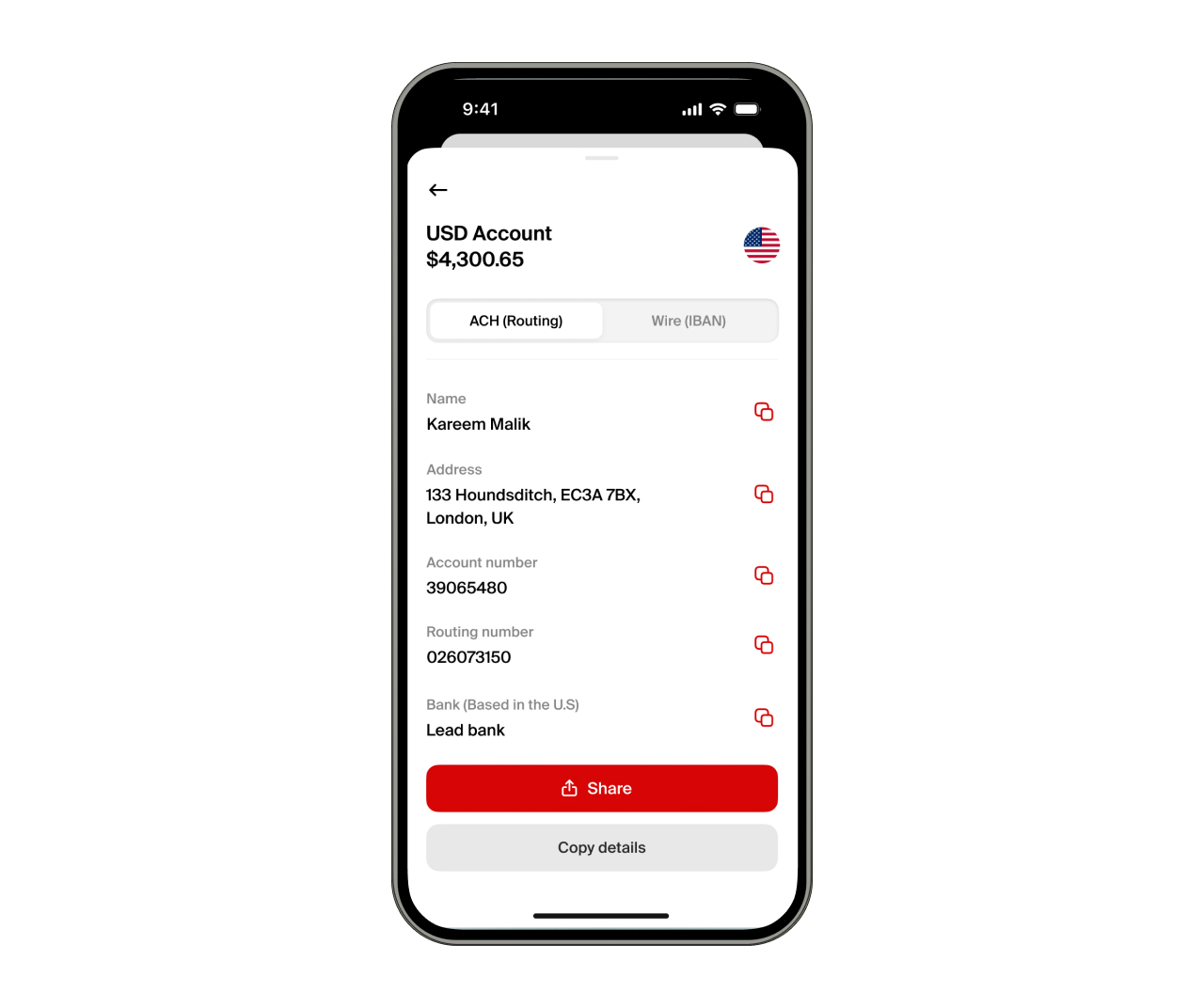
To receive USD via nsave, update your payout settings on your platform. There are 5 common payout destinations Pakistani freelancers configure with nsave ACH details:
- Upwork: Settings → Get Paid → US Bank (ACH) → enter your nsave routing number and account number
- Fiverr: Earnings → Withdraw → Bank Transfer → enter the same ACH details
- Toptal, Freelancer.com, PeoplePerHour: navigate to each platform's bank payout setup and enter the same ACH details
- Direct clients: add your nsave ACH routing number and account number to your standard invoice
- SWIFT-paying clients from the UK, EU, or Australia: share your nsave SWIFT receiving details, available inside the app.
Step 3: Hold USD and Access Investment Options
nsave provides the opportunity to earn 3.2% annual rewards on your USD balance on the Standard plan, paid daily, or 4.2% on the Pro plan at $9.99 per month. Your USD balance can be held for weeks or months according to your own timeline. nsave also gives you access to invest in US stocks, ETFs, gold indices, or bonds from as little as $1 with no order fees, with Sharia-compliant options available.
Investments involve risks, including the potential loss of capital. Past performance is not indicative of future results. Data provided is for illustrative purposes only. Consult a licensed financial adviser before making any investment decisions. Investment accounts are provided by a third-party broker dealer.
Step 4: Convert to PKR and Withdraw
To withdraw from nsave, tap Withdraw in the app and send funds to any local Pakistani account, with the exact PKR amount displayed before you confirm.

nsave is not a bank. Funds are not FSCS-protected. Customer funds are held in regulated UK and EEA financial institutions, separated from company funds, and protected through safeguarding rules designed for electronic money services.
Pakistani freelancers on platforms like Upwork and Fiverr earn in USD but have historically faced limited options for holding those earnings in a stable currency before converting. The ability to hold USD in a personal account, access Sharia-compliant investment options, and convert to PKR on your own schedule gives freelancers from Pakistan a degree of control over the timing of their conversions that was not easily accessible before. The structural steps to set this up take under 10 minutes.
Pakistani earners today navigate financial infrastructure that was simply not available a decade ago. A freelancer in Lahore, a developer in Karachi, or a remote worker in Islamabad can receive USD from an international client, hold it in a digital account before converting, and choose when to bring it home. The regulatory framework, from the 2023 ESFCA liberalisation to the 2026 bank facilitation mandate, has moved consistently toward giving Pakistani digital earners more control over their own income. What each earner does with that access belongs entirely to them.
Frequently Asked Questions
1. Can I keep my USD in Pakistan without converting to PKR?
Yes. Pakistani freelancers retain USD without converting to PKR through 2 channels: an ESFCA (Exporters' Special Foreign Currency Account) at an SBP-authorised bank such as Bank Alfalah, UBL, or Meezan Bank, or a USD-holding fintech account such as nsave that holds balances in USD until the account holder initiates a PKR withdrawal.
2. Does the SBP allow freelancers to hold foreign currency?
Yes. Under SBP EPD Circular Letter No. 17 of 2023, IT, software, ITeS, and freelance exporters can retain up to 50% of export proceeds in an ESFCA without mandatory PKR conversion. The remaining 50% converts to PKR at the point of receipt into the banking system. Some banks apply 100% retention for monthly inflows below $5,000 equivalent, though application of this rule is inconsistent across institutions.
3. What happens to my USD if I do not instruct my bank within 30 days?
For funds arriving via SWIFT into a local bank account, SBP rules require the receiving bank to seek the account holder's instruction on whether to retain the funds as USD or convert to PKR. If no instruction is given within the required window, the bank may convert the funds to PKR at the prevailing rate. This rule does not apply to funds held in international fintech accounts such as nsave, because those funds have not yet entered the Pakistani banking system.
4. Can I use a USD account in Pakistan to pay for subscriptions like Adobe or Notion?
Partially. Standard ESFCA accounts at most Pakistani banks do not natively support recurring international subscription payments like ChatGPT Pro, Netfli . According to the r/PakistaniTech community, users report that Bank Alfalah's ESFCA includes a linked USD debit card usable for international online purchases, and Faysal Bank's freelancer account includes a foreign currency debit card. For subscriptions where local bank cards are declined, nsave provides a USD account with card access for international billing systems.
5. Does USD received into a Pakistani bank account qualify for the SBP's remittance incentive scheme?
Yes, with conditions. Foreign remittances converted to PKR through official banking channels qualify for the government's remittance incentive scheme. USD retained in an ESFCA does not trigger the incentive until liquidated into PKR. Transfers above $5,000 equivalent may require supporting documentation such as a client contract or PSEB certificate to qualify.
6. Can I receive a USD salary from a foreign employer in Pakistan?
Yes. Pakistani residents receive USD salaries from foreign employers through 2 methods: a direct SWIFT wire transfer into an ESFCA or FCY account at an SBP-authorised bank, or an ACH or wire transfer into a fintech account such as nsave, which then routes funds to a Pakistani bank account in PKR. The first method retains USD locally. The second method gives the account holder a choice of when to convert.
7. Will my USD account in Pakistan affect my tax return?
Yes. Foreign income arriving in a Pakistani bank account with the IT/ITeS purpose code 9186 attracts a 1% withholding tax, automatically deducted by the bank at the point of receipt. According to the r/pakistan community, users report that this withholding tax satisfies the annual tax obligation for that foreign income, meaning it does not need to be declared again in the yearly tax filing. Registering with PSEB reduces the withholding rate to 0.25%. Domestic income earned from Pakistani clients remains taxable under standard income slabs regardless of registration status.
8. Can I send USD from my Pakistani ESFCA to someone abroad?
Yes, with conditions. Under SBP FE Manual Chapter 6, Paragraph 1(v), FCY accounts under the FE-25 scheme are free from all foreign exchange restrictions, giving account holders the freedom to remit funds abroad for any purpose to the extent of their available balance. In practice, outbound transfers from an ESFCA require a branch instruction at most banks. SBP EPD Circular Letter No. 17 of 2023 also removed the restrictive list of permitted outbound uses for ESFCA funds, replacing it with general current-account payment freedom, meaning IT and freelance exporters can make payments abroad of a current-account nature without prior SBP approval.
9. Is there a limit on how much USD I can hold in Pakistan?
There is no published maximum balance cap for USD held in an FE-25 FCY account. For ESFCA accounts, freelancers and IT exporters may retain up to 50% of export proceeds in USD, with the remaining 50% subject to mandatory PKR conversion under SBP EPD Circular Letter No. 17 of 2023. Accounts where monthly aggregate activity exceeds the equivalent of $10,000 for individuals or $25,000 for entities are subject to SBP reporting requirements under FE Manual Chapter 6, Paragraph 12A.
10. Can I open a USD account in Pakistan as a student?
Yes, with proof of income. Student status does not disqualify an applicant from an FCY account, but income documentation does. Students without freelance earnings, a scholarship record, or equivalent foreign income proof cannot open an ESFCA at an SBP-authorised bank. Students without qualifying documentation use fintech accounts or platform wallets to manage foreign currency for education expenses instead.
11. Can I use Payoneer to receive and hold USD in Pakistan?
Yes. Payoneer is widely used by Pakistani freelancers on Upwork and Fiverr, and supports PKR withdrawals to local bank accounts. Payoneer accepts ACH and SWIFT transfers and integrates with most major freelance platforms.
12. Can I use Wise to hold and convert USD in Pakistan?
According to the r/PakistaniTech community, users report across multiple threads that Wise is no longer allowing new receiving account registrations from Pakistan-based users. Existing Wise accounts opened before the restriction continue to function, but new Pakistani users cannot set up Wise as an inward payment solution. For freelancers setting up USD receipt infrastructure from scratch, nsave or a local ESFCA account are the available alternatives.
The information in this article is provided for general informational and educational purposes only and does not constitute financial, legal, or tax advice from nsave or any of its affiliates. It is not a substitute for advice from a qualified financial adviser. We make no representations or warranties, whether expressed or implied, that the content is accurate, complete, or up to date.
Fees, exchange rates, incentives, and product availability may change and can vary by user and jurisdiction. Examples are illustrative only. Before making any financial decisions, seek advice from a qualified financial adviser who can assess your individual circumstances and objectives.
nsave helps freelancers and professionals from Bangladesh, Nigeria, Pakistan, Egypt, and other emerging markets receive and manage USD abroad. As a non-bank payment provider, your money is not protected by the Financial Services Compensation Scheme (FSCS). Customer funds are held in regulated, UK and EEA financial institutions, separated from company funds, and protected through safeguarding rules designed for electronic money services.
